


Does Temperature Matter? The Science of a Warm Dram

I want to begin with a moment at a tasting that I suspect will be familiar to many readers. Someone pours a dram, takes an immediate sip, and declares it disappointing - thin, perhaps, or oddly harsh, or simply underwhelming given what the label had promised. The glass is set down. The conversation moves on. Twenty minutes later, the glass is picked up again - and the experience is entirely different. More aromatic, more layered, more generous. The same whisky. The same person. A different temperature.
What changed was not the whisky. It was the physics of what the whisky was doing.
This article is about temperature: why it matters more than most people realise, what the science says about the optimal range for experiencing whisky and how to think about ice - a subject that generates more heat in whisky circles than almost any other. Along the way, I want to connect this to the science of taste, the chemistry of water and whisky, and the aesthetics of the drinking environment which we explored in our previous articles.
The Physics of Flavour Release
To understand why temperature matters, it helps to revisit something from our article on the science of taste: the fact that approximately 80% of what we perceive as flavour comes not from the tongue but from the nose - specifically from the olfactory system, via the retronasal pathway. ¹ The complexity of a well-made whisky - the fruit, the spice, the smoke, the vanilla, the dried flowers, the coastal air - arrives almost entirely through volatile aromatic compounds reaching the olfactory epithelium.
The critical word is volatile. For an aromatic compound to be detected by the nose, it must leave the liquid and become airborne - entering what chemists call the headspace above the glass, where the nose can reach it. And the rate at which the rate at which they escape from the liquid into the air, or volatilise, is directly governed by temperature.
This is the physics of flavour. At lower temperatures, molecular motion slows. Aromatic compounds remain more tightly bound within the liquid matrix, their tendency to escape into the headspace suppressed by the reduced kinetic energy of the system. At higher temperatures, molecular motion increases, and the boundary between liquid and vapour becomes more active. Volatile compounds migrate to the surface and release into the air at a faster rate, producing a richer, more complex aromatic signal above the glass. ²
This is why the glass you set down disappointing and picked up twenty minutes later tasted different. It had simply come to temperature.
What the Research Shows
The empirical evidence on whisky serving temperature is consistent and worth stating precisely.
A study evaluating identical single malts at three temperatures - 8°C, 16°C, and 22°C - produced clear results. At 8°C, 78% of tasters reported muted top notes and reduced aromatic complexity. At 22°C, 64% detected significantly more layered fruit and spice. At 16–18°C, tasters achieved what the researchers described as optimal balance: sufficient volatility for aroma release without the overwhelming alcohol vapour that can dominate at higher temperatures. ³
The French whisky guide Limonadier summarises the practical temperature ranges usefully: between 18 and 20°C, aromatic molecules are released gradually, allowing the nose to detect light notes - fruit, flowers - followed by middle notes - spices, honey - and finally the deeper notes of wood, leather, and peat. Below 15°C, aromas remain trapped in the liquid. Above 24°C, ethanol evaporates first and saturates the nose, obscuring everything beneath it. ⁴
Japanese distilleries, whose approach to precision in the tasting experience we explored in our article on single malt terminology, explicitly recommend 15–18°C for nosing. Kentucky bourbon producers advise against refrigeration for premium expressions.
The practical implication is simple: a whisky poured and tasted immediately - especially if the glass has been stored in a cool room or the bottle has been sitting away from warmth - will often be tasted at a temperature below its optimal range. A few minutes of patience, and ideally the warmth of the hand on the glass, will change the experience considerably.
The Hand as Temperature Instrument
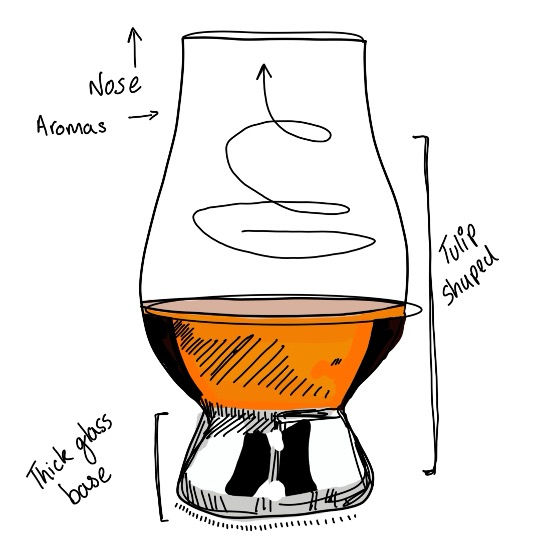
The Glencairn glass, as we noted in our aesthetics article, has a solid base specifically designed to be cradled in the hand. ⁵ The palm of the hand maintains a surface temperature of approximately 32–35°C - well above the optimal aromatic release range for whisky. When the bowl of a Glencairn is held in the cupped hand, the glass conducts warmth into the liquid at a gentle, controllable rate.
The effect is gradual and can be modulated. A light hold - the base resting on the fingers - will warm the whisky slowly and gently, which is appropriate for a complex, multi-layered dram where you want the aromatics to open in sequence. A closer cup - the bowl held in both palms - warms faster, which can be useful for a closed, reticent whisky that needs coaxing. This is not ritual for its own sake. It is the conscious use of the body as a precision instrument for temperature control.
Pendleton Whisky’s tasting notes articulate this well: the warmth of the hands is typically sufficient to release all the subtleties of the spirit without overwhelming the palate. ⁶ The hand is a better tool for this purpose than any mechanical warming device, precisely because it is connected to the same sensory system that will evaluate the result. You can feel when the glass is warm enough. A machine cannot.
The Case Against Ice: Built on Chemistry
Here is where I expect some disagreement, and I want to make the case clearly and honestly.
Adding ice to whisky does three things simultaneously, and none of them are straightforwardly beneficial to the experience of a complex, high-quality dram.
First, it suppresses aromatic release. As the temperature drops toward 8°C - the lower end of the range tested in the sensory study above - volatile aromatic compounds return to solution. The headspace above the glass empties. The nose detects less. The lighter, more delicate aromatics - citrus, floral, sea spray, green apple - which are the first to be suppressed by cold, are often the most interesting and characterful notes in a single malt. Chilling does not preserve them. It silences them. ⁷
Second, it alters the flavour balance irreversibly. Cold temperature does not suppress all aromatic compounds equally. Heavier compounds - oak, peat smoke, certain phenols - are more resistant to cold suppression than lighter esters. The result of chilling is not simply a quieter whisky. It is a different whisky: one in which the heavier, more robust notes dominate and the lighter, more nuanced ones recede. This may be acceptable for a rough blend, but it represents a significant loss in a sherried Speyside or a floral Highland single malt. ⁸
Third, melting ice dilutes - unevenly. As ice melts, the dilution is not uniform. The first sip may be relatively undiluted; the last, significantly watered down. This is different from the deliberate addition of a small amount of room-temperature water, which we explored in depth in our water and whisky article: the Karlsson-Friedman research showed that a few drops of water at ambient temperature releases guaiacol and other surface-active aromatic compounds by breaking the ethanol-molecule clusters that trap them. ⁹ Cold water - and certainly melting ice - produces the opposite thermal effect, reducing volatility at the same time as diluting, and driving aromatic compounds back into solution rather than releasing them.
There is a fourth consideration that deserves mention: chill filtration. Distilleries that bottle below 46% ABV frequently chill-filter their whisky - cooling it to between 5 and 10°C and passing it through a fine filter to remove the long-chain fatty acids and esters that would otherwise precipitate out as cloudiness when the spirit is chilled or diluted. ¹⁰ The debate about whether this process removes flavour compounds is ongoing; some distilleries, including Arran, have taken a public position against chill filtration for their higher-ABV expressions on precisely these grounds. ¹¹ Adding ice to a non-chill-filtered whisky at cask strength can drop the ABV below the critical threshold of approximately 46%, causing the very haze that chill filtration is designed to prevent. For a whisky purist, this visible precipitation is not a flaw. It is a sign that the spirit retains its full complement of oils and esters - and that these are now, briefly, visible.
Is There Any Case for Ice?
Yes - and I want to state it fairly, because I think the whisky world’s occasional absolutism on this question is unhelpful.
Ice is not wrong. It is a choice with specific trade-offs, and there are contexts in which those trade-offs are entirely reasonable.
For lower-quality blends or heavily robust spirits, ice can genuinely improve the experience. A blend dominated by harsh alcohol heat, served neat at room temperature, can be uncomfortable. Chilling suppresses the top notes - but if the top notes are harsh rather than complex, their suppression is a benefit rather than a loss. The heaviness and sweetness of the base notes may actually be more enjoyable at a lower temperature.
In hot weather, the case for some form of chilling is straightforward. Whisky served at 22°C in a cool English study is a different proposition from whisky served at 28°C on a warm Devon evening. The Japanese Mizuwari - whisky served over a large, perfectly formed ice sphere, lengthened with still water - is a serve developed for precisely this context: humid summers where a room-temperature dram would be unpleasant. ¹² The ice sphere, with its low surface-area-to-volume ratio, chills slowly and dilutes minimally, giving something closer to a controlled temperature reduction than a blunt thermal intervention.
For whisky cocktails, the question of ice is largely moot. The role of whisky in a cocktail is as a flavour component within a broader construction, and the temperature, dilution, and integration effects of ice are part of the design rather than a distortion of it.
Whisky stones - soapstone or stainless steel cubes stored in the freezer - offer a partial middle path: they chill the whisky without diluting it. They do not overcome the volatility suppression problem - chilling is chilling, regardless of the mechanism - but they at least avoid the uneven dilution of melting ice. For someone who genuinely prefers the texture and reduced heat of a cooler dram without wanting it diluted, they are a reasonable option.
The Sweet Spot: A Practical Summary
Drawing the science together, here is where I land:
The optimal range for most single malt Scotch, Irish single malt, and Japanese whisky is 16–20°C - slightly above the typical cool room temperature in a British home, and well above refrigerator or ice temperature. This is the range in which aromatic compounds are released gradually and in sequence: light notes first, middle notes developing on the palate, deeper notes emerging on the finish.
For cask-strength expressions - typically 55–65% ABV - the upper end of this range can emphasise the alcohol vapour uncomfortably. Here, the appropriate intervention is not ice but a few drops of room-temperature water, which reduces ABV without suppressing temperature, and which the Karlsson-Friedman research showed actively releases aromatic compounds rather than suppressing them. ¹³
For robustly flavoured bourbons and heavier blends, the range can be extended slightly - 16–22°C - because the dominant vanilla, caramel, and wood notes are more resistant to temperature-related suppression.
For a warm summer evening, a large ice sphere or whisky stones can bring the temperature into a comfortable range without catastrophic dilution. Enjoy it for what it is - a different, cooler experience - rather than pretending it is the same as a properly tempered dram.
And in all circumstances: warm the glass in your hands before you judge what is in it.
A Final Observation
There is something I find genuinely moving about the fact that whisky - a liquid that has spent years in a cask, absorbing compounds from the wood through the slow physics of temperature change - is also a liquid so sensitive to temperature at the moment of drinking. The distillery harnesses heat and cold across years of maturation to build the flavour. The drinker, in those final few minutes, can honour or undermine that work with something as simple as the warmth of a palm.
This is one reason why the Glencairn glass is designed to be held rather than simply set down. It is an invitation to participate in the last stage of the process - to bring your own warmth to the whisky, as the warehouse and the cask have done before you.
At Devon Drams, we pour at room temperature and we encourage patience. The best thing you can do for a good dram, in our experience, is give it a few minutes, hold it properly, and let it open on its own terms.
Come and find out what we mean at our next event.
Devon Drams articles referenced in this piece
What Are You Actually Tasting? The Science Behind Every Dram - on retronasal olfaction and the brain’s construction of flavour.
Water and Whisky: What Happens Inside You When You Drink - on the Karlsson-Friedman research and the science of dilution.
Everything Around the Glass: The Aesthetics of Whisky - on the Glencairn glass, the hand hold, and the environment of tasting.
What Does “Single Malt” Actually Mean? - on Japanese whisky, serving traditions, and the Mizuwari serve.
External Sources
1. Vocal Media / Feast. How Temperature Affects the Flavor of Your Drink. Available at: https://vocal.media/feast/how-temperature-affects-the-flavor-of-your-drink (Accessed: June 2026).
2. Alibaba Product Insights. Why Do Scottish Pubs Serve Whisky at Room Temperature? Available at: https://www.alibaba.com/product-insights/why-do-scottish-pubs-serve-whisky-at-room-temperature.html (Accessed: June 2026).
3. Limonadier. At What Temperature Should Whisky Be Enjoyed? Available at: https://limonadier.co/en/blogs/the-spirits-review/temperature-degustation-whisky (Accessed: June 2026).
4. Pendleton Whisky. Chilled or Warm: How Does Whisky Temperature Affect Taste? Available at: https://pendletonwhisky.com/news-story/chilled-or-warm-how-does-whisky-temperature-affect-taste/ (Accessed: June 2026).
5. Cotswolds Distillery. The Ultimate Guide to Drinking Whisky Neat, With Ice or Water. Available at: https://www.cotswoldsdistillery.com/blogs/advice/complete-guide-on-how-to-drink-whisky (Accessed: June 2026).
6. The Whisky Exchange. Should You Put Ice in Your Whisky? Available at: https://thewhiskyexchange.com/inspiration/article/18350/ice-in-whisky (Accessed: June 2026).
7. Devon Drams. Water and Whisky: What Happens Inside You When You Drink. devondrams.com/news (Accessed: June 2026).
8. Wikipedia. Chill Filtering. Available at: https://en.wikipedia.org/wiki/Chill_filtering (Accessed: June 2026).
9. Arran Whisky. Arran Whisky’s Approach to Chill Filtration. Available at: https://www.arranwhisky.com/news/312-arran-whiskys-approach-to-chill-filtration (Accessed: June 2026).
10. The Whisky Exchange. Should You Put Ice in Your Whisky? Available at: https://thewhiskyexchange.com/inspiration/article/18350/ice-in-whisky (Accessed: June 2026).
11. Karlsson, B. and Friedman, R. (2017). ‘Dilution of whisky - the molecular perspective’, Scientific Reports, 7, 6489. Available at: https://www.nature.com/articles/s41598-017-06423-5 (Accessed: June 2026).


Comments