


Water and Whisky: What Happens Inside You When You Drink


There is a question I am asked regularly at Devon Drams tastings, usually towards the end of the evening: “Should I be drinking water alongside this?”
My answer- which I will set out in full - is always yes. But the more interesting question is why. What does alcohol do to the body’s water balance?
I want to be clear from the outset: what follows is not a recommendation to drink alcohol. It is an honest account of the science, written for those who already enjoy whisky and want to do so with a better understanding of what is happening inside them when they do. I also want to flag that I am writing here about moderate, responsible consumption- the kind of measured enjoyment we have discussed in a previous article on sensible drinking. Heavy or prolonged alcohol use carries risks that go far beyond hydration, and this article does not address those.
With that said - let us look at what alcohol actually does.
The Hormone You Have Never Heard Of
The story of alcohol and dehydration begins not in the stomach or the bladder, but in the brain- specifically in a small region of the hypothalamus that produces a hormone called vasopressin, also known as antidiuretic hormone (ADH).
ADH is the body’s primary water-conservation signal. It is released from the posterior pituitary gland in response to rising blood osmolality- that is, when the blood is becoming more concentrated, usually because you have not drunk enough fluid.1 When ADH is present in the bloodstream, the collecting ducts of the kidneys insert water transport proteins called aquaporins into their cell membranes, allowing water to be reabsorbed back into the body rather than passed out as urine.2 The result: less urine, better hydration.
Alcohol disrupts this system directly. Ethanol inhibits the release of ADH from the pituitary gland, reducing circulating levels of the hormone.3 With ADH suppressed, the kidneys can no longer effectively reabsorb water. The aquaporins are not inserted. The collecting ducts become relatively impermeable. And water that would normally be retained instead flows through into the bladder.
The effect is measurable and begins quickly. Research has shown that alcohol can produce increased urine flow within approximately twenty minutes of consumption.4 Studies suggest that for every gram of alcohol consumed, urine excretion can increase by up to 10ml.5 A standard measure of spirits can generate an additional 100–140ml of urine output. Over the course of an evening of moderate drinking, the cumulative fluid deficit can become meaningful.
What You Are Losing- and Why It Matters
The fluid lost through alcohol-induced diuresis is not simply water. As the kidneys produce larger volumes of dilute urine, they also excrete electrolytes: the minerals -sodium, potassium, and magnesium in particular- that are essential for nerve signalling, muscle contraction, and maintaining the body’s fluid balance at a cellular level.6
This distinction matters clinically. When you lose fluids containing electrolytes, you cannot fully restore your hydration status only by drinking water. Water will dilute the remaining electrolytes in your blood further before it moves into the cells where it is needed. This is why people who drink large quantities of plain water alongside heavy alcohol consumption can feel simultaneously overhydrated and symptomatic -the cellular dehydration persists even as blood volume is restored.
It also explains the characteristic symptoms of the morning after. Headaches following heavy drinking are in part caused by mild cerebral dehydration - the brain, which is roughly 73% water, is sensitive to fluid shifts.7 Fatigue and muscle weakness reflect both electrolyte depletion and the metabolic burden of processing acetaldehyde, a toxic compound produced when the liver breaks down ethanol.8 Dry mouth and persistent thirst reflect the body’s ongoing effort to signal its need for fluid repletion.
It is worth noting- because this is often misunderstood -that dehydration does not fully explain the alcohol hangover. A landmark 2024 study led by Utrecht University, following participants through controlled drinking sessions, found that while dehydration is a real and measurable consequence of alcohol consumption, it accounts for only a proportion of hangover symptoms.9 Inflammation, disrupted sleep architecture, blood sugar fluctuations, and the direct toxic effects of acetaldehyde all contribute independently. Hydration helps -but it is not a cure.
A Note on Beer, Wine, and Spirits
Not all alcoholic drinks dehydrate you equally. The diuretic effect of alcohol is dose-dependent- it scales with the concentration of ethanol, not simply with the volume of liquid consumed.10
Beer, at 4–5% ABV, delivers a significant volume of water alongside a relatively modest amount of alcohol, and research has shown that standard-strength beer can produce urine output broadly comparable to the same volume of water -the diuretic effect of the alcohol is partially offset by the hydrating effect of the large fluid volume.11 Wine and spirits, at higher concentrations, produce a more pronounced diuretic response relative to the volume consumed.
This is one reason why spirits - including whisky - deserve particular attention in relation to hydration. A 50ml measure of whisky at 40% ABV delivers relatively little water alongside a significant diuretic stimulus.
Water in the Glass: A Separate Consideration
There is a separate, and rather beautiful, reason to add water to whisky -one that has nothing to do with hydration, but everything to do with flavour.
In 2017, researchers Björn Karlsson and Ran Friedman of Linnaeus University in Sweden published a study in Scientific Reports examining what happens to flavour molecules in whisky when water is added.12 Using molecular dynamics simulations, they tracked the behaviour of guaiacol- a key molecule responsible for the smoky, peated character in many whiskies- at different ethanol concentrations.
Their finding was striking. At ethanol concentrations above 59% ABV, guaiacol molecules are drawn into the body of the liquid, surrounded by ethanol, where they are less accessible to the nose and palate. As the whisky is diluted - whether to the standard 40% bottling strength, or further with a few drops of water in the glass -guaiacol migrates toward the liquid-air interface, where it can be more readily detected as aroma and taste.13
The practical implication of adding small amounts of water to high ABV whisky is that flavour profiles open, which were otherwise locked in the body of the liquid. This is especially noticeable for the aromatic profiles of drams at higher strengths.
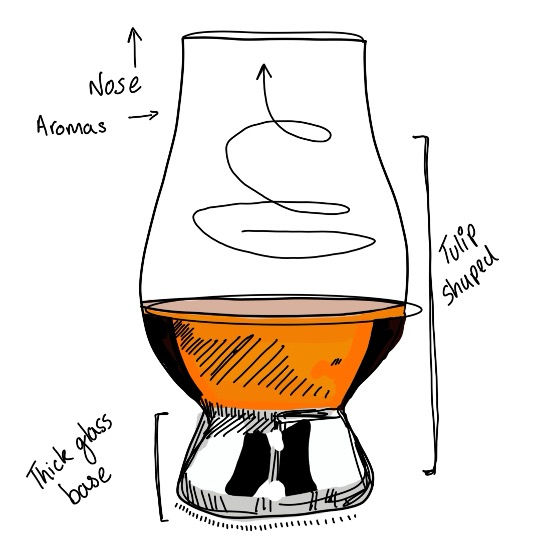
This is also why the Glencairn glass, as explored in one of our earlier articles, works so well: its tulip-shaped bowl concentrates these surface-active aromatic compounds toward the narrow rim, where the nose can reach them. The glass and the water drop are working together with the same molecular logic.
Practical Hydration: What the Evidence Actually Supports
So what should you do? Here is what the science supports, stated plainly.
Before you drink: Arriving well hydrated makes a meaningful difference. If you have been physically active, spent time in the sun, or simply had a busy day and not drunk much water, your body starts the evening with a fluid deficit that alcohol will worsen. Drink a glass of water before your first dram.
Alongside your drinks: Alternating alcoholic drinks with water - or, better, a water containing some electrolytes - helps offset the diuretic effect without simply adding to blood volume. One glass of water per dram is a sensible and practical rule.
After drinking: Water helps, but plain water alone is not the most efficient rehydration fluid if you have been drinking substantially. Electrolytes -particularly sodium- facilitate water absorption at the cellular level and help the body retain the fluid you take in. A glass of water with a small amount of sodium-containing food before bed- a few crackers, some light soup- addresses both needs. Commercial electrolyte preparations work on the same principle.
What does not help: There is no evidence that coffee, further alcohol, or any specific supplement meaningfully accelerates recovery from alcohol-related dehydration. Sleep, time, water, and electrolytes remain the best tools available.
What This Means in Practice at Devon Drams
I think about this every time I lead or attend a tasting. The etiquette of water in a whisky context is interesting: many enthusiasts feel conflicted about whether to add water to a dram, as though it somehow diminishes the experience. I hope the science above helps reframe that.
Water and whisky have always belonged together - not just physiologically, but chemically. The distillers use it to bring the spirit to bottling strength. The molecules within the whisky are shaped by it. The flavour is, in part, released by it. And the body that experiences all of this needs it.
At Devon Drams events, we always make water available alongside every tasting. This is not politeness -it is physiology. Drink your water. Your brain, your kidneys, and your palate will all thank you.
Sources:
1. National Center for Biotechnology Information. “Physiology, Vasopressin.” StatPearls. Available at: https://www.ncbi.nlm.nih.gov/books/NBK526069/ (Accessed: June 2026).
2. TeachMePhysiology. “Antidiuretic Hormone — Synthesis, Action.” Available at: https://teachmephysiology.com/urinary-system/regulation/antidiuretic-hormone/ (Accessed: June 2026).
3. Taivainen, A. H. et al. (1995). “Role of Plasma Vasopressin in Changes of Water Balance Accompanying Acute Alcohol Intoxication.” Alcoholism: Clinical and Experimental Research. Available at: https://pubmed.ncbi.nlm.nih.gov/7573805/ (Accessed: June 2026).
4. Nuun Hydration. “How Does Dehydration Affect a Hangover?” Available at: https://nuunlife.com/blogs/news/how-does-dehydration-affect-a-hangover (Accessed: June 2026).
5. CyAlcohol. “Why Alcohol Dehydrates: Understanding the Science Behind the Hangover.” Available at: https://cyalcohol.com/article/why-alcohol-dehydrates (Accessed: June 2026).
6. Alcohol Awareness. “Does Alcohol Dehydrate You? Signs, Symptoms, and Why.” Available at: https://alcoholawareness.org/does-alcohol-dehydrate-you/ (Accessed: June 2026).
7. Paulev, P. E. and Zubieta-Calleja, G. (2004). Essentials of Medical Physiology. General reference to water content of brain tissue.
8. Apollo Pharmacy. “Electrolyte Drinks for Hangovers: The Scientific Truth.” Available at: https://www.apollopharmacy.in/blogs/article/electrolyte-drinks-for-hangovers (Accessed: June 2026).
9. Mackus, M. et al. (2024). “Alcohol Hangover versus Dehydration Revisited: The Effect of Drinking Water to Prevent or Alleviate the Alcohol Hangover.” ScienceDirect. Available at: https://www.sciencedirect.com/science/article/pii/S0741832924001009 (Accessed: June 2026).
10. Alcohol Awareness. “Is Alcohol a Diuretic? How It Affects Hydration and Urination.” Available at: https://alcoholawareness.org/is-alcohol-a-diuretic/ (Accessed: June 2026).
11. Alcohol Awareness. “Does Alcohol Dehydrate You?” Available at: https://alcoholawareness.org/does-alcohol-dehydrate-you/ (Accessed: June 2026).
12. Karlsson, B. and Friedman, R. (2017). “Dilution of Whisky — The Molecular Perspective.” Scientific Reports, 7, 6489. Available at: https://www.nature.com/articles/s41598-017-06423-5 (Accessed: June 2026).
13. Arran Whisky. “The Whisky and Water Relationship.” Available at: https://www.arranwhisky.com/news/149-the-relationship-between-whisky-and-water (Accessed: June 2026).


Comments