


What Are You Actually Tasting? The Science Behind Every Dram


I trained as a doctor. I spent years learning how the human body works -how it fails, how it heals, how its systems communicate with one another in ways that still astonish me. And yet, when I first began to take whisky seriously, I realised I had never properly considered taste, one of the most fundamental things the body does every day.
It seemed simple enough. Nose it. Sip it. Swallow. But the more I investigated the science, the more I have discovered that tasting a dram of whisky is one of the most sophisticated, neurologically complex experiences in human life. This understanding has changed the way I approach every glass, and it may, even in the smallest way, do the same to you.
The Tongue: A More Limited Instrument Than You Think
Let us start with the tongue, because most people assume it is doing most of the work. It is not.
The tongue contains between 2,000 and 5,000 taste buds, clustered within the papillae- those small, raised bumps you can see and feel on the surface of the tongue.1 Each taste bud houses 50 to 100 individual taste receptor cells, and these cells can detect exactly five basic tastes: sweet, sour, salty, bitter, and umami- the savoury depth found in aged cheeses, cured meats, and, as it happens, certain long-matured whiskies.2 That is it. Five signals. Everything else you think you are tasting - the vanilla, the dried fruit, the peat smoke, the Christmas cake, the sea air- that is not coming from your tongue at all.
You may also have encountered the old diagram of the “tongue map,” assigning different tastes to different regions: sweet at the tip, bitter at the back, and so on. This map, it turns out, is largely a myth. Modern research indicates that taste receptors are broadly distributed across the tongue, not neatly zoned.3 The map was a misinterpretation of early 20th-century German research and has persisted in textbooks long past its scientific usefulness. One of many reminders
that even established knowledge needs revisiting.
The Nose: Where the Real Complexity Lives
Here is the part that, as a former clinician, I find genuinely remarkable. Approximately 80% of what we perceive as flavour comes not from the tongue but from the nose — specifically from the olfactory system.4
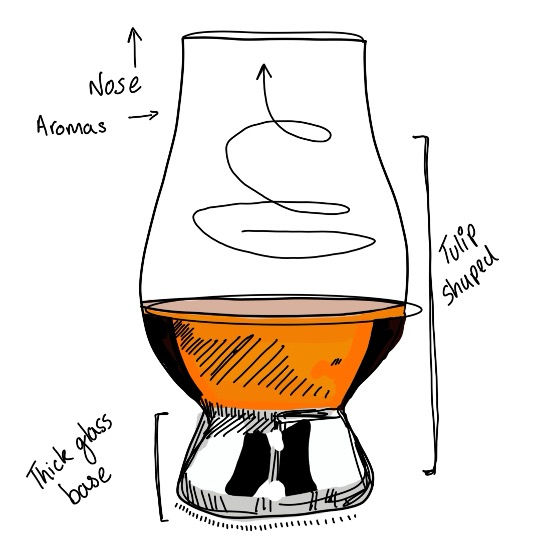
We tend to think of smelling as something we do from the outside: you bring a glass to your nose and inhale. This is called orthonasal olfaction - detecting aromas that travel in through the nostrils from the external environment. It is what you experience when you nose a Glencairn glass, and it is powerful.
But there is a second olfactory pathway that is, if anything, more important to the experience of flavour. When you take a sip of whisky and it sits in your mouth, volatile aromatic compounds travel up behind the palate and reach the olfactory epithelium -the scent-detecting tissue at the back of the nasal cavity from the inside, via the nasopharynx. This is called retronasal olfaction, and it is the primary mechanism through which we experience the complexity of what we eat and drink.5
The two pathways feel different, and they are neurologically different. Research published in Current Biology demonstrated that retronasal odours activate the brain’s taste processing regions -particularly the insular cortex -in a way that orthonasal odours do not.6 In other words, the aromas you experience while the whisky is in your mouth are being processed by the same part of your brain that handles taste itself. The nose and the palate are, at a neurological level, working together as one integrated system.
This is why experienced tasters spend time with a whisky in their mouth before swallowing -not affectation, but physiology. The longer the spirit is in contact with the warm, moist environment of the mouth, the more aromatic compounds are released retronasally, and the fuller the flavour picture becomes.
The olfactory system itself is remarkably capable. Humans possess approximately 350 different olfactory receptor subtypes, working in combinations that allow us to detect around 10,000 distinct odours.7 Whisky, depending on its style and age, may contain hundreds of volatile aromatic compounds - esters, aldehydes, phenols, terpenes - each contributing a thread to the overall tapestry. The skill of the experienced taster is not a gift, it is a trained ability to disaggregate those threads.
The Brain: Where Flavour Is Actually Made
Here is the most important insight of all, and the one I find myself returning to most often: flavour is not a property of the whisky. It is constructed by the brain.
What you taste is not simply the objective molecular composition of the liquid in your glass. It is the brain’s interpretation of sensory signals, filtered through memory, expectation, context, emotion, and prior experience. The same whisky, served under different conditions, can taste genuinely different -not because it has changed, but because the brain processing it has.
A landmark series of neuroimaging studies demonstrated this with striking clarity. When participants were told a wine was expensive before tasting it, they reported it as tasting better- and their brains responded differently too, with increased activity in the regions associated with reward and pleasure. The change in experience was not a superficial response bias; the cortical representation of the taste itself was altered.8 Price, in other words, can function as an ingredient.
Colour exerts a similar influence. Research has shown that the colour of a drink primes taste expectations automatically and unconsciously, biasing the subsequent flavour experience toward what the visual signal led the brain to anticipate.9 If a whisky appears a deep amber, drinkers will often perceive richer, heavier flavours before the liquid has touched their lips.
The implications of this for how we approach a tasting are considerable. When we are told by a knowledgeable companion or a confident label- what we should expect to taste, we are more likely to taste it. This is not weakness or gullibility; it is how human perception works. Expectations are not obstacles to accurate tasting. They are part of the tasting itself.
What This Means for Memory — and for Medicine
As a doctor, I am particularly struck by how intimately the olfactory system connects to memory and emotion. The olfactory bulb- the brain structure that first processes smell signals has direct anatomical connections to the hippocampus and the amygdala: the structures most closely associated with memory formation and emotional response.10 No other sensory system has this kind of direct access.
This is why a particular whisky can unexpectedly take you somewhere. Why a specific combination of peat smoke and coastal salt can feel like a memory of somewhere you have never been. Why the first dram of something truly familiar feels like coming home. These are not sentimental metaphors. They reflect real neurological architecture.
It also explains why scent is uniquely powerful in triggering involuntary autobiographical memories -a phenomenon known to neuroscientists as the Proust Effect, after Marcel Proust’s famous description of being transported by the smell of a madeleine cake.11 Whisky, with its enormous aromatic complexity, is perhaps uniquely positioned among drinks to produce this effect.
It is worth noting, too, that olfactory function declines with age in a way that other senses do not always. The olfactory neurons that detect smell are among the few neurons in the adult body capable of regenerating -but this capacity diminishes over time.12 This is one reason elderly individuals often add more salt to food -not because their taste buds have failed, but because the retronasal olfactory contribution to flavour has reduced, and what they perceive as taste is therefore diminished.
Practical Implications for Your Next Tasting
Understanding the science changes how I approach a glass. A few things I now do differently:
· Take the nose seriously. The orthonasal experience — what you detect before the whisky reaches your lips — is setting the stage for everything that follows. Spend time with it. Let the spirit open. A few drops of water, which reduces the alcohol concentration and releases more aromatic compounds, can dramatically alter what you can detect.
· Slow the palate. The retronasal pathway needs time. A small sip held in the mouth for a few seconds, breathing out gently through the nose, will reveal layers that an immediate swallow will not.
· Be honest about context. If you are tasting a whisky you have been told is extraordinary, or one poured from an impressive bottle, or one shared in good company, expect your perception to be elevated by those facts. This is not a flaw in your assessment- it is part of what the experience is. The best tastings are social, contextual, and memorable for reasons that go beyond the liquid.
· And above all: trust your own nose. The science tells us that flavour is a uniquely personal construction, shaped by your specific genetics, your memories, your history with particular aromas, and the particular architecture of your olfactory receptors. There is no universally correct response to a whisky. There is only your response- and understanding why that is so is, I think, the beginning of a much richer relationship with what is in your glass.
At Devon Drams, these are exactly the conversations we love to have. Come and find us at one of our tastings and let the science do its work.
Sources:
1. EBSCO Research Starters. “Taste Bud.” Available at: https://www.ebsco.com/research-starters/health-and-medicine/taste-bud (Accessed: June 2026).
2. Wikipedia. “Taste.” Available at: https://en.wikipedia.org/wiki/Taste (Accessed: June 2026).
3. Medicine LibreTexts. “Tastes and Odors.” Available at: https://med.libretexts.org/Bookshelves/Anatomy_and_Physiology/Anatomy_and_Physiology_(Boundless)/13 (Accessed: June 2026).
4. The Sensory Advantage. “Flavour Is an Illusion: How Your Brain Creates Taste and Perception.” Available at: https://www.thesensoryadvantage.com/blog/flavour-is-an-illusion-how-your-brain-creates-taste-and-perception (Accessed: June 2026).
5. Rebello, M. R., Kandukuru, P. and Verhagen, J. V. (2015). “Direct Behavioral and Neurophysiological Evidence for Retronasal Olfaction in Mice.” PLOS ONE. Available at: https://www.ncbi.nlm.nih.gov/pmc/articles/PMC4326425/ (Accessed: June 2026).
6. Katz, D. B. et al. (2019). “Retronasal Odor Perception Requires Taste Cortex, but Orthonasal Does Not.” Current Biology. Available at: https://www.cell.com/current-biology/fulltext/S0960-9822(18)31477-5 (Accessed: June 2026).
7. Medicine LibreTexts. “Tastes and Odors.” Available at: https://med.libretexts.org/Bookshelves/Anatomy_and_Physiology (Accessed: June 2026).
8. Plassmann, H. et al. (2017). “How Context Alters Value: The Brain’s Valuation and Affective Regulation System Link Price Cues to Experienced Taste Pleasantness.” Scientific Reports. Available at: https://pmc.ncbi.nlm.nih.gov/articles/PMC5556089/ (Accessed: June 2026).
9. Spence, C. et al. (2022). “Exploring the Links between Colours and Tastes/Flavours.” Journal of Perceptual Imaging. Available at: https://library.imaging.org/jpi/articles/5/0/jpi0149 (Accessed: June 2026).
10. Takeda, S. (2009). “Olfaction and the Hippocampus.” Psychogeriatrics. General reference to olfactory-hippocampal anatomy.
11. Herz, R. S. (2004). “A Naturalistic Analysis of Autobiographical Memories Triggered by Olfactory, Visual and Auditory Stimuli.” Chemical Senses, 29(3), pp. 217–224.
12. Biology LibreTexts. “Taste and Smell.” Available at: https://bio.libretexts.org/Courses/Cosumnes_River_College/Introductory_Anatomy_and_Physiology_(Aptekar)/07:_Senses/7.04:_Taste_and_Smell (Accessed: June 2026).


Comments